USA Proxies: 4,756,709 US Residential, ISP & Mobile IPs
Buy USA proxies backed by 4,756,709+ American residential IPs, plus static ISP, datacenter, IPv6 and USA mobile carrier addresses. Every US proxy type we sell is covered here — rotating residential from $0.39/GB, dedicated static ISP from $6.99/month, and USA 4G mobile from $3.99/GB. Choose rotating USA proxies for scale or private, dedicated US IPs for account work. Target all 51 states and 1,918 cities down to the city level, hold a sticky session for up to 24 hours, or rotate on every request. Our US pool is ethically sourced, works over HTTP, HTTPS and SOCKS5, and places no cap on concurrent connections.

Trusted by top partners in the industry
Nine plans cover the United States. Pick rotating residential for scale, static ISP for accounts that need the same American IP every day, or datacenter for raw speed.
Bypass CAPTCHA blocks effortlessly
Bypass CAPTCHA blocks effortlessly and ensure fast, reliable scraping with top-tier residential proxies designed for high performance and anonymity.
35M+ Active IPs
Access geo-restricted content with authentic residential IPs
Avoid detection with high anonymity and rotating IPs
Starts from
$2.29
/GBUSA Proxies by State
We carry US IPs in all 50 states plus Washington DC — 1,918 cities in total. California alone has 198 cities, Texas 156 and Florida 143. Pick a state to see its coverage.
USA Residential Proxies: Rotating IPs in All 50 States
Our residential proxies are the default choice for USA traffic. They are real IP addresses assigned by American ISPs — Comcast, Spectrum, AT&T, Verizon and hundreds of regional providers — to real households. To the site you are visiting, a request through one of these looks like an ordinary person browsing from Ohio or Georgia, because at the network layer that is exactly what it is.
The US pool holds 4,756,709 addresses, the largest single-country pool we operate and part of a 35M+ global network. That depth matters more than it sounds: sites that rate-limit by IP only become a problem when you exhaust the pool, and at nearly five million American IPs most scraping jobs never revisit the same address twice.
Rotating vs sticky sessions
USA rotating proxies assign a fresh American IP to every single request. This is what you want for high-volume collection — price monitoring, search result scraping, catalogue crawls — where each request is independent and being seen as one continuous visitor is a liability rather than a benefit.
Sticky sessions do the opposite: they pin one US IP to your session for up to 24 hours. Use these whenever state has to survive between requests — logging into an account, walking through a checkout, or any multi-step flow that breaks the moment your IP changes mid-journey.
You choose per request, not per plan. Both modes are included on every residential plan, so a single set of credentials can run a rotating crawler and a sticky account session at the same time.
Which residential plan
- Residential Budget — $0.39/GB. The cheapest way into the US pool. Best when volume matters more than the very highest success rate.
- Residential — $2.29/GB. The standard tier, with the full 35M+ pool and 195+ countries if your project later outgrows the US.
- Unlimited Residential Budget — $5.00/day. Unmetered bandwidth billed by time instead of gigabytes, which is far cheaper once you are moving serious volume.
- Unlimited Residential — $20.00/hour, with 9M+ active IPs on a server dedicated to you alone.
Static ISP & Dedicated USA Proxies
A rotating pool is the wrong tool when a platform expects to see you arrive from the same place every time. That is the job of static ISP proxies: an American residential IP, registered to a real US internet provider, that is assigned to you and nobody else for as long as you keep the plan. These are sold under several names — private USA proxies, dedicated USA proxies, static residential USA proxies — and they all describe the same thing: a US IP with a single tenant.
That single-tenant part is the distinction that matters. On a rotating pool the IPs are shared, so the reputation of any given address reflects whatever everyone else did with it. On a private US proxy the address is yours exclusively and its reputation is shaped by your traffic alone. For anything tied to a long-lived identity — a social account, an ad platform login, a marketplace seller dashboard, a recurring report pull — that exclusivity is the whole point, and it is why dedicated USA residential proxies cost more per IP than pooled ones.
Static ISP or static datacenter?
Both give you a fixed US IP. They differ in what the address traces back to:
- Static ISP — $6.99/month. The IP resolves to a consumer ISP, so it carries residential trust. This is the one to pick for platforms that scrutinise where a login comes from.
- Static Datacenter — $4.99/month. The IP resolves to a hosting provider. Noticeably faster and cheaper, and perfectly adequate for targets that do not weigh IP origin heavily.
Both are month-to-month. If you are unsure which side of that line your target sits on, a small order on each is the fastest way to find out — it costs less than a day of guessing.
USA Datacenter & IPv6 Proxies
USA datacenter proxies trade residential trust for raw throughput. The IPs come from American hosting facilities rather than homes, which makes them dramatically faster and cheaper — $3.00/day — but also trivially identifiable as non-residential to any site that checks.
That trade-off is fine, and often correct, for a large class of work: hitting public APIs, monitoring your own infrastructure from a US vantage point, load testing, checking DNS and CDN behaviour on American edge nodes, or bulk-fetching pages from sites with no meaningful bot defences. Reach for datacenter first when the target does not care where you come from, and only step up to residential when it does.
IPv6 in the United States
We also run IPv6 across both flavours — IPv6 residential and IPv6 datacenter, each $3.00/day. The US is one of the few markets where IPv6 adoption is high enough for this to be genuinely useful rather than a novelty: major American carriers and content networks all speak it natively.
The practical draw is address space. IPv6 blocks are vast enough (80 Octillion addresses) that per-IP rate limits stop being a meaningful constraint at all. The catch is equally practical — a target that has not deployed IPv6 simply cannot be reached over it, so confirm your destination resolves an AAAA record before you commit. Our IPv6 test tool answers that in a few seconds.
USA Mobile Proxies: 4G, 5G and LTE Carrier IPs
USA mobile proxies route your traffic through IP addresses that American cellular carriers hand out to phones on 4G, 5G and LTE. Our Mobile USA plan covers this at $3.99/GB, with a pool of 50K+ dedicated AT&T carrier addresses. It is bought from the pricing page rather than the plan selector above, which lists our bandwidth and dedicated-IP plans.
They are the most expensive US proxies we sell, and there is a structural reason they are also the hardest to block. Mobile carriers put thousands of subscribers behind a single public IP through carrier-grade NAT. A platform that blocks one mobile IP is not blocking one user — it is blocking an entire cell tower's worth of real customers. Most decide the collateral damage is not worth it, which is why mobile addresses survive on targets where residential IPs start failing.
When the premium is worth paying
- Mobile-first platforms. TikTok, Instagram and Snapchat expect their US traffic to arrive from phones. A carrier IP is simply the ordinary case there, where a datacenter IP is an anomaly.
- Hardened account work. Where residential IPs are triggering verification steps, carrier IPs usually stop it.
- Mobile ad verification. Checking what a US mobile user actually sees requires being a US mobile user at the network level.
For anything less sensitive, US residential is a better buy — the success rate is close and the cost is a fraction. Our wider mobile proxy network extends the same approach to more than 100 other countries if your work is not US-only.
State and City-Level Targeting Across the US
Country-level targeting is rarely precise enough for American work. Retail pricing, tax, delivery windows, ad creative, sports blackouts and legal restrictions all vary between states and often between metros in the same state. A proxy that lands you somewhere in the US tells you very little about what a shopper in Sacramento actually sees.
We expose all three levels through the proxy password. Append the parameters to your password and the gateway routes you accordingly — no separate endpoints, no dashboard round-trip:
- Country:
USER:PASS_country-us@HOST:PORT - State:
USER:PASS_country-us_state-california@HOST:PORT - City:
USER:PASS_country-us_state-california_city-losangeles@HOST:PORT
State and city names are lowercase with spaces removed, so New York becomes newyork and Los Angeles becomes losangeles. Because the whole instruction lives in the password field, it works with any client that supports proxy authentication — curl, Scrapy, Playwright, Puppeteer, an off-the-shelf browser extension — without special support for our API.
Where the coverage is deepest
The US pool spans 51 states and 1,918 cities. Coverage tracks population, so the largest states carry the most granularity: California 198 cities, Texas 156, Florida 143, Ohio 122, New York 105, North Carolina 104, Georgia 85 and Illinois 78. Smaller states have fewer cities but every one of the 50 states plus Washington DC is represented.
Our California and Pennsylvania pages go deeper on those two markets, and the state grid above links to the rest.
How Much USA Proxies Cost
US pricing runs from $0.39/GB for budget residential up to $3.99/GB for dedicated mobile carrier IPs. What you should actually pay depends far more on how your target defends itself than on how much data you plan to move.
| USA proxy type | From | Billing | Best for |
|---|---|---|---|
| Residential Budget | $0.39/GB | Per GB | High-volume scraping on a budget |
| Residential | $2.29/GB | Per GB | The general-purpose default |
| Unlimited Residential Budget | $5.00/day | Per day | Heavy, sustained bandwidth |
| Mobile USA | $3.99/GB | Per GB | TikTok, Instagram, hardened targets |
| Static ISP | $6.99/month | Per month | Long-lived US accounts |
| Static Datacenter | $4.99/month | Per month | A fixed US IP, speed first |
| Datacenter | $3.00/day | Per day | APIs and undefended targets |
| IPv6 Datacenter | $3.00/day | Per day | IPv6-ready destinations |
Per-GB plans suit spiky or exploratory work where you would rather not commit; per-day and per-month plans win decisively once usage is steady. The crossover usually arrives sooner than people expect — if you are consistently moving more than a few gigabytes a day, unlimited is already cheaper.
Rather than model it, test it. A free trial or a $2 order is enough to run your actual target through a US IP and read a real success rate instead of a projected one. Full plan comparisons live on the pricing page.
Free USA Proxies vs Paid: What Actually Changes
Free US proxy lists are easy to find and, for a narrow set of uses, fine. If you want to confirm that a page renders differently from an American IP, or check a geo-redirect once, a free proxy answers the question and costs nothing. There is no reason to pay for that.
They stop being viable the moment the work is repeated or matters. Public lists are scraped and republished constantly, so the same handful of addresses is hammered by thousands of people at once — which is why most entries are dead within hours and the survivors are already on every major blocklist. Uptime is unpredictable, throughput is poor, and there is nobody to ask when it breaks.
The security gap deserves more attention than it usually gets. A proxy operator sees your traffic. Running an unencrypted request through an anonymous server means handing your data to someone whose motives you know nothing about, and free HTTP proxies have a long, documented history of injecting ads, stripping TLS and harvesting credentials. Never send a login through one.
Paid US proxies fix the operational problems — a pool of 4,756,709 addresses instead of a shared few dozen, state and city targeting, sticky sessions, HTTP and SOCKS5, and a support team that answers within a few hours — but the honest framing is that you are buying reliability and accountability, not magic. If your use case genuinely is one lookup, a free proxy is the right call. If it is a job that has to finish, it is not.
Either way, verify before you trust: our free proxy checker tests any proxy's country, anonymity level and response time, whoever it came from.
HTTP, HTTPS and SOCKS5 Support
Every USA plan speaks HTTP, HTTPS and SOCKS5 on the same credentials. There is no protocol upcharge and no separate endpoint to provision — switch by changing the scheme in your connection string.
- HTTP / HTTPS — the right default for web traffic. Understands requests at the HTTP layer, which means it can cache and handle CONNECT tunnelling for TLS. Supported by essentially every scraping library, browser and HTTP client.
- SOCKS5 — operates lower down, forwarding raw TCP (and UDP) without interpreting it. That makes it protocol-agnostic: anything that is not HTTP — mail, custom TCP services, torrent clients, some automation tooling — works over SOCKS5 and will not work over an HTTP proxy.
One detail worth getting right: prefer socks5h:// over socks5:// in curl and most libraries. The h makes DNS resolve at the proxy rather than on your machine. Without it your own resolver leaks the hostname you are visiting, and you also lose US-local DNS — which matters, because plenty of American sites return different records by region.
Concurrent connections are not capped on any plan, so protocol choice is purely about what your client needs rather than what your licence allows.
Why Use a USA Proxy Server?
The United States is the most heavily geo-segmented market on the internet. Pricing, inventory, ad creative and content libraries all change by state — and most of it is invisible without an American IP.
US E-commerce Data
Amazon, Walmart, Target and Best Buy all vary price, stock and promotions by delivery region. A US proxy shows you the listing an American shopper actually sees, down to their ZIP-level assortment, instead of the export-market version.
Web Scraping at Scale
Rotate through 4,756,709 American IPs so per-IP rate limits never become the bottleneck. Collect pricing, catalogue and review data continuously without your crawler tripping volume defences. See web scraping.
Ad Verification by State
Campaigns render differently in Texas and New York, and affiliate fraud hides in exactly that gap. City-level US targeting lets you confirm your creative, landing page and payout terms are what you bought — see ad verification.
US Social & Mobile Platforms
TikTok, Instagram and Facebook weight American traffic by its network origin. Residential and Mobile USA carrier IPs let US-facing accounts operate from a location consistent with the audience they target.
SEO & SERP Monitoring
Google localises results aggressively inside the US. Checking rankings from a single vantage point tells you almost nothing — city-level American IPs let you see the SERP as it appears in each market you compete in.
Competitive Intelligence
Track US competitor pricing, launches and promotions from IPs indistinguishable from ordinary customer traffic, so your monitoring does not announce itself or get fed a different page than everyone else.
Who Uses Our USA Proxies?
Commercial applications: Retailers and marketplace sellers track American competitor pricing across states. Data teams run continuous collection against US sites without hitting rate limits. Ad-tech and affiliate networks verify what US audiences are served. Agencies check localised Google results city by city. Brand protection teams find counterfeit US listings that only surface to domestic shoppers, and fintech teams test that their own products behave correctly across state lines.
Institutional use: Academic and public-interest researchers use US IPs to study algorithmic personalisation, pricing discrimination and political ad targeting across American regions — work that is impossible from a single vantage point. Journalists and NGOs use the same access to document what different US communities are shown online.
A free trial or a $2 test order is enough to measure the real success rate against your own targets before you scale up.
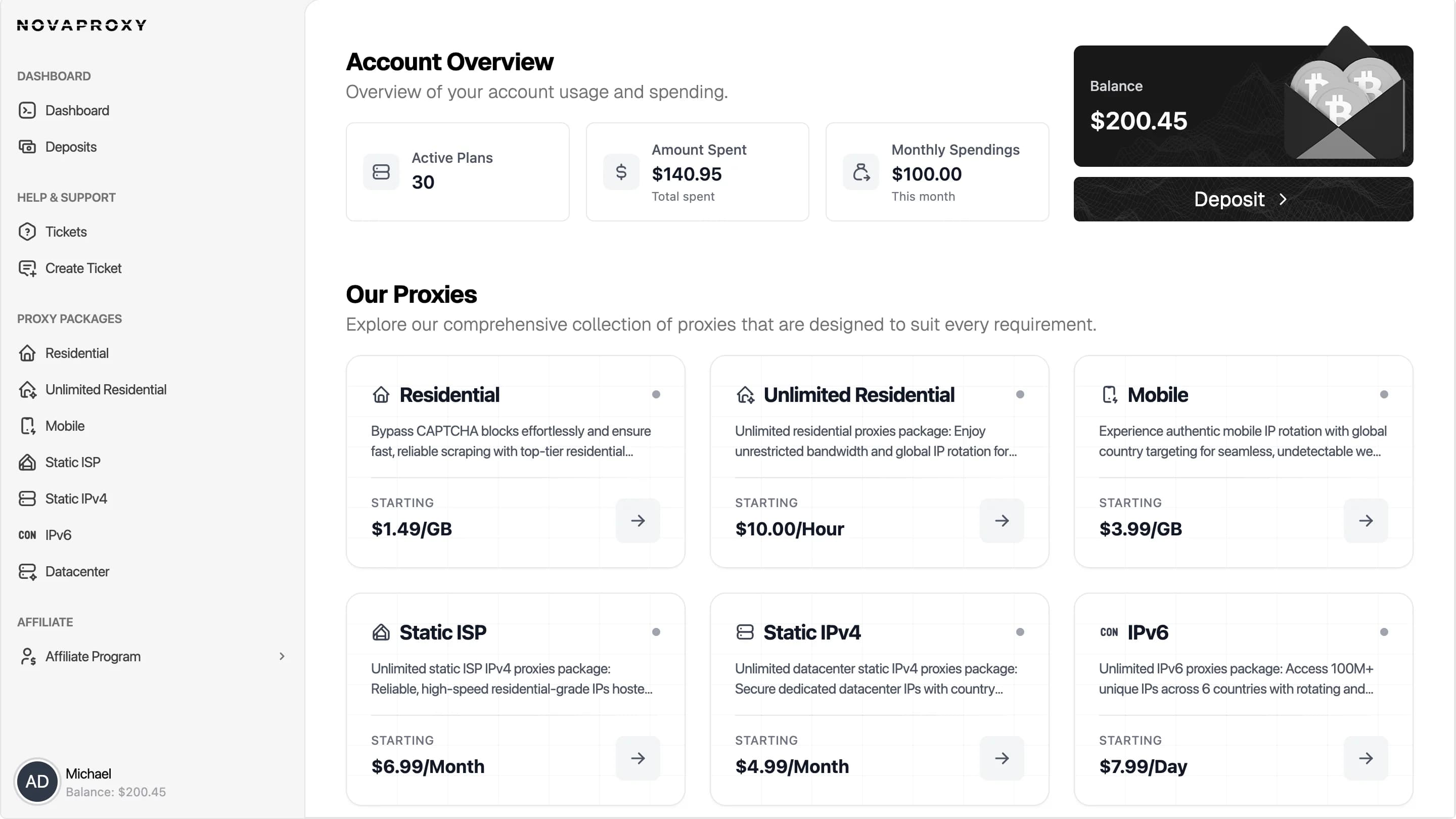
Popular Use Cases for USA Proxies
Web Scraping
Email Protection
AI Data Collection
Price Comparison
SEO Monitoring
Ad Verification
United States proxies by type, and the markets next door
Every plan below can target United States; open a product page for pool size, per-GB and per-day pricing, and session options.
- United States residential proxiesfrom $2.29/GB
- Unlimited residential proxies in United Statesfrom $20.00/hour
- United States mobile proxies (4G/5G)from $3.49/GB
- IPv6 proxies in United Statesfrom $3.00/day
- United States IPv6 residential proxiesfrom $3.00/day
- United States datacenter proxiesfrom $3.00/day
- United States static ISP proxiesfrom $6.99/month
- Dedicated datacenter proxies in United Statesfrom $4.99/month


USA Proxies: Frequently Asked Questions
Coverage, pricing, targeting and protocol questions about our US proxy network.

